Q1 2026 was defined by a decisive institutional shift in the Web3 events landscape. Two major conferences — Digital Asset Summit (DAS) NYC and EthCC[9] in Cannes — anchored the quarter with over 130 side events and attracted the world’s largest financial institutions, regulators, and asset managers. Three themes dominated: tokenization of real-world assets, stablecoins as payment infrastructure, and US policy clarity. Together, these signals show that institutional capital deployment into digital assets has shifted from exploration to execution.
Developer activity concentrated around three focal points: ETHDenver dominated North American building with $1.5M+ in bounties and heavy focus on AI-onchain integration, zero-knowledge proofs, and DePIN infrastructure. Hackathons across the quarter reflected the same priorities: AI agents, autonomous trading systems, and verifiable finance were the dominant projects. Geographic reach expanded — while North America and Europe led, Hong Kong emerged as the APAC institutional center, with meaningful signals from LATAM, Eastern Europe, and Sub-Saharan Africa. Every event referenced in this report is listed on Web3Voyager.
Q1 Overall Narrative
Q1 2026 marks a structural inflection: institutional finance and onchain infrastructure converged from theory into practice. The quarter concentrated around flagship conferences — DAS NYC and EthCC[9] anchored dense, high-signal side event ecosystems. Builder communities pushed simultaneously into AI-native and privacy-preserving architectures. Meanwhile, US regulatory clarity and advancing MiCA implementation in Europe provided institutional investors with the policy infrastructure they needed to engage.
Key Dynamics
- Institutional players, such as BlackRock, JPMorgan, SEC leadership, and sovereign wealth funds, now shape Web3 events agenda directly. They are no longer observers but participants setting the terms of discussion
- AI-blockchain integration dominated builder priorities across all event types: hackathons, side summits, and main tracks. AI agents, autonomous onchain systems, and decentralized AI infrastructure were not speculative — they represented active building efforts with dedicated funding and accelerator programs
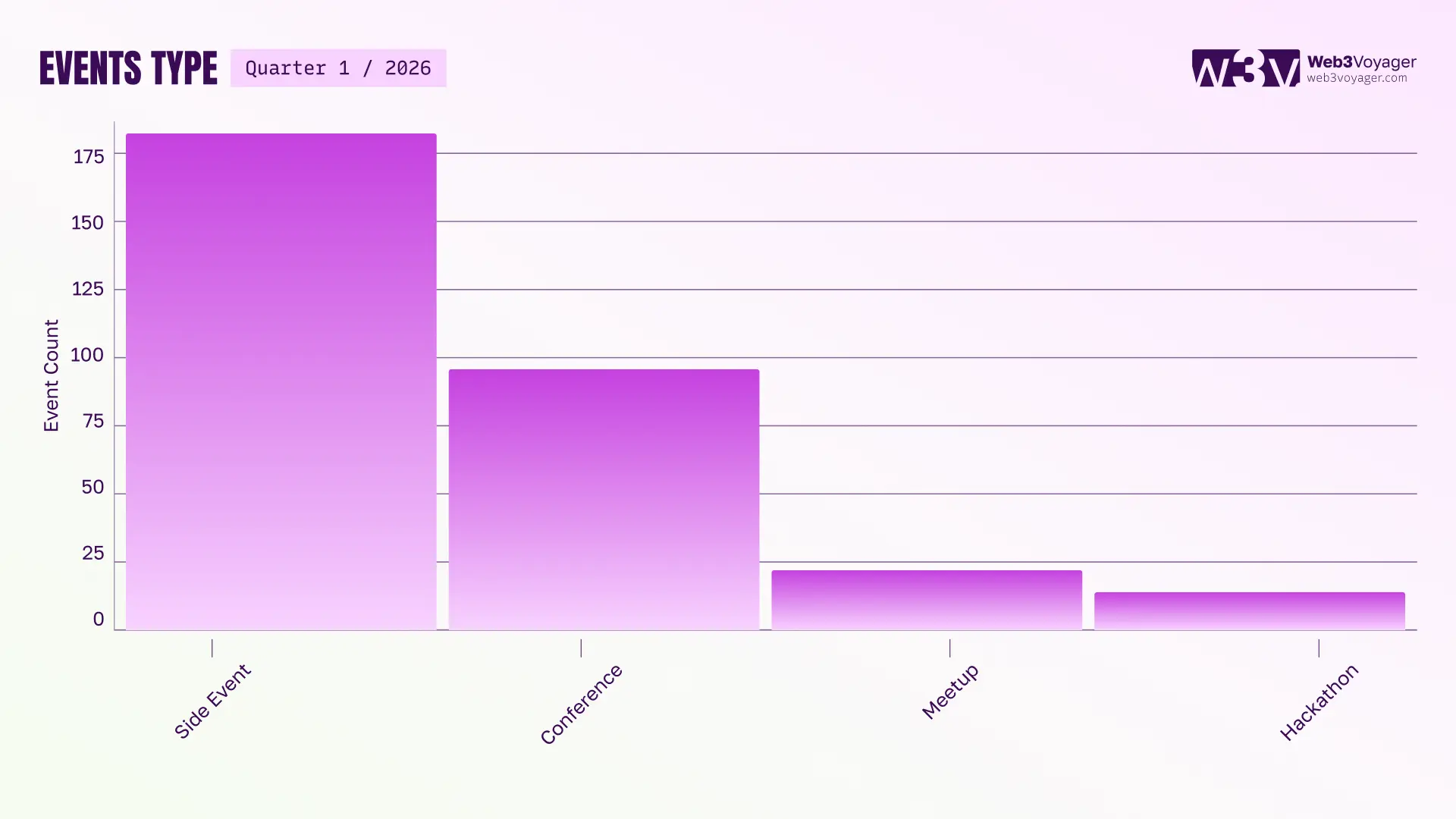
- Side event ecosystems matured into a core layer of the quarter’s activity. DAS NYC alone generated 73 satellite events — from institutional security workshops to stablecoin payment rail demonstrations. This shift shows where high-value deal-making actually occurs: in curated, invitation-only formats outside the main conference.
Ecosystem Landscape
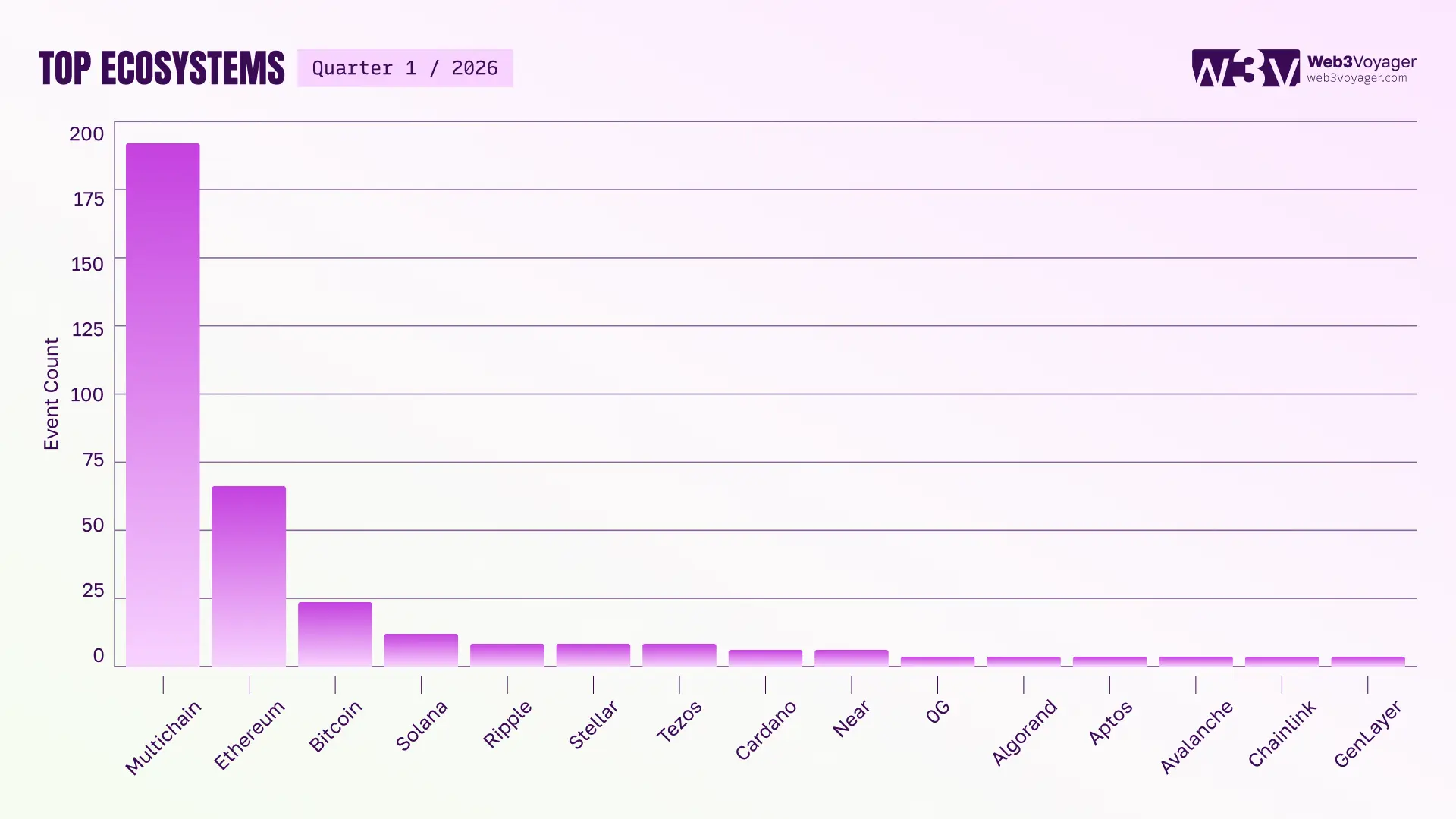
Web3 events in Q1 split geographically between North America and Europe, with New York and Cannes as the two poles. New York focused on institutional deployment; Cannes on developer infrastructure. Hong Kong anchored APAC’s institutional layer. LATAM, Eastern Europe, and Sub-Saharan Africa showed growing independent activity. Multichain events (55%) dominated institutional tracks where buyers remain chain-agnostic; Ethereum gatherings (22%) maintained depth in developer and technical programming.
Regional Patterns
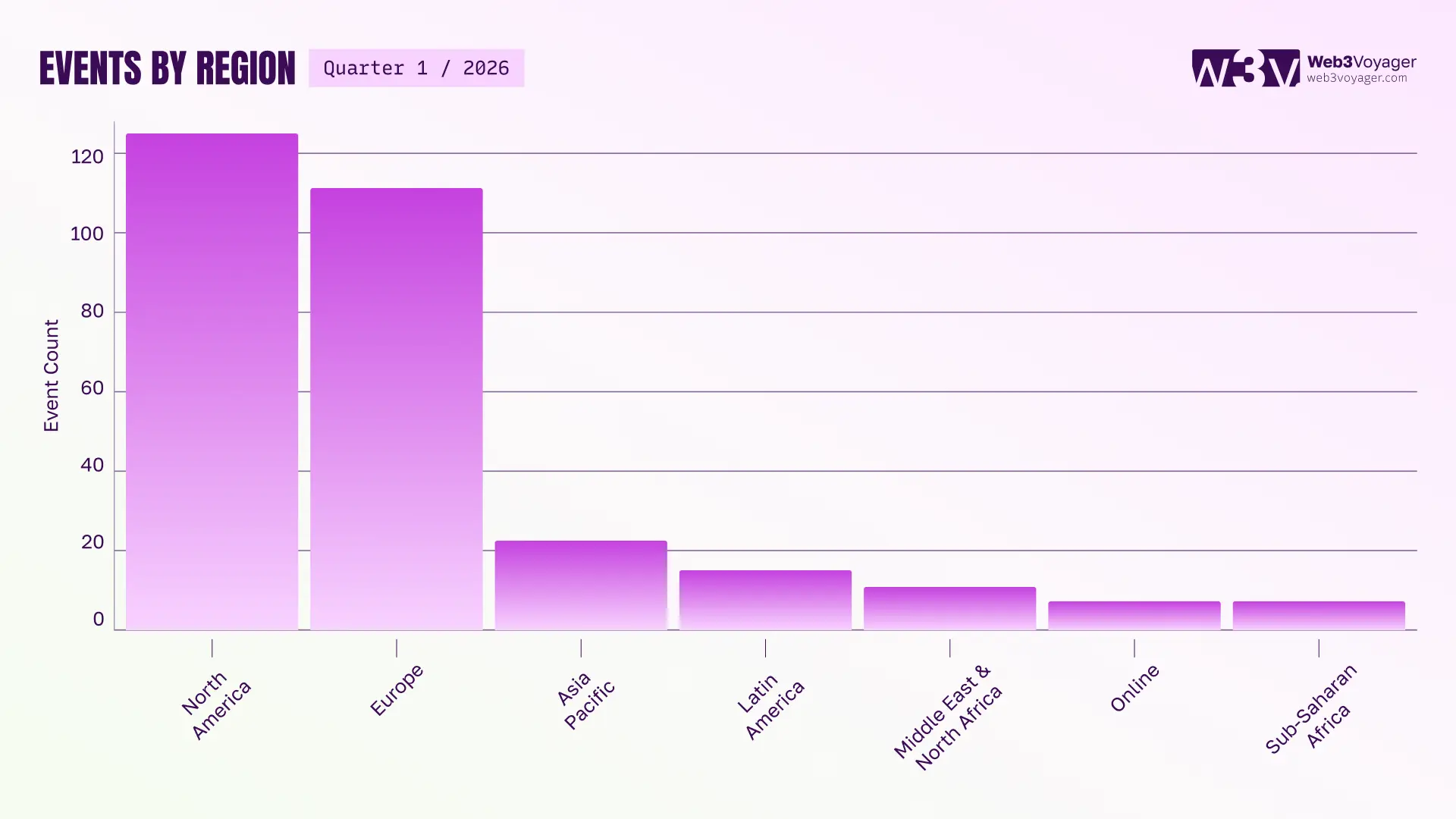
- North America (41 main events) split between institutional and developer activity. New York hosted the quarter’s largest side event cluster around DAS; Denver anchored developer momentum. US regulatory shifts dominated discussions in both cities
- Europe (53 main events, the largest regional count) split between institutional-regulatory hubs in the West (Cannes, London, Paris) and growing community infrastructure in the East (Warsaw, Katowice). Poland emerged as a new multichain community center.
Ecosystem Patterns
- Ethereum dominated developer programming. EthCC[9] and ETHDenver together defined the quarter’s technical depth: scaling, zero-knowledge proofs, staking infrastructure, and DAO governance appeared only in Ethereum-tagged tracks
- Solana split strategy: consumer-facing events in Hong Kong paired with AI agent hackathons. This shows a two-pronged approach — capturing institutional APAC capital while building AI-native consumer applications
- Bitcoin programming focused on institutional themes: treasury management, energy policy, sovereign adoption, financial products (life insurance, ETFs). No developer building — Bitcoin conferences cemented its role as a macro asset class.
City Hubs
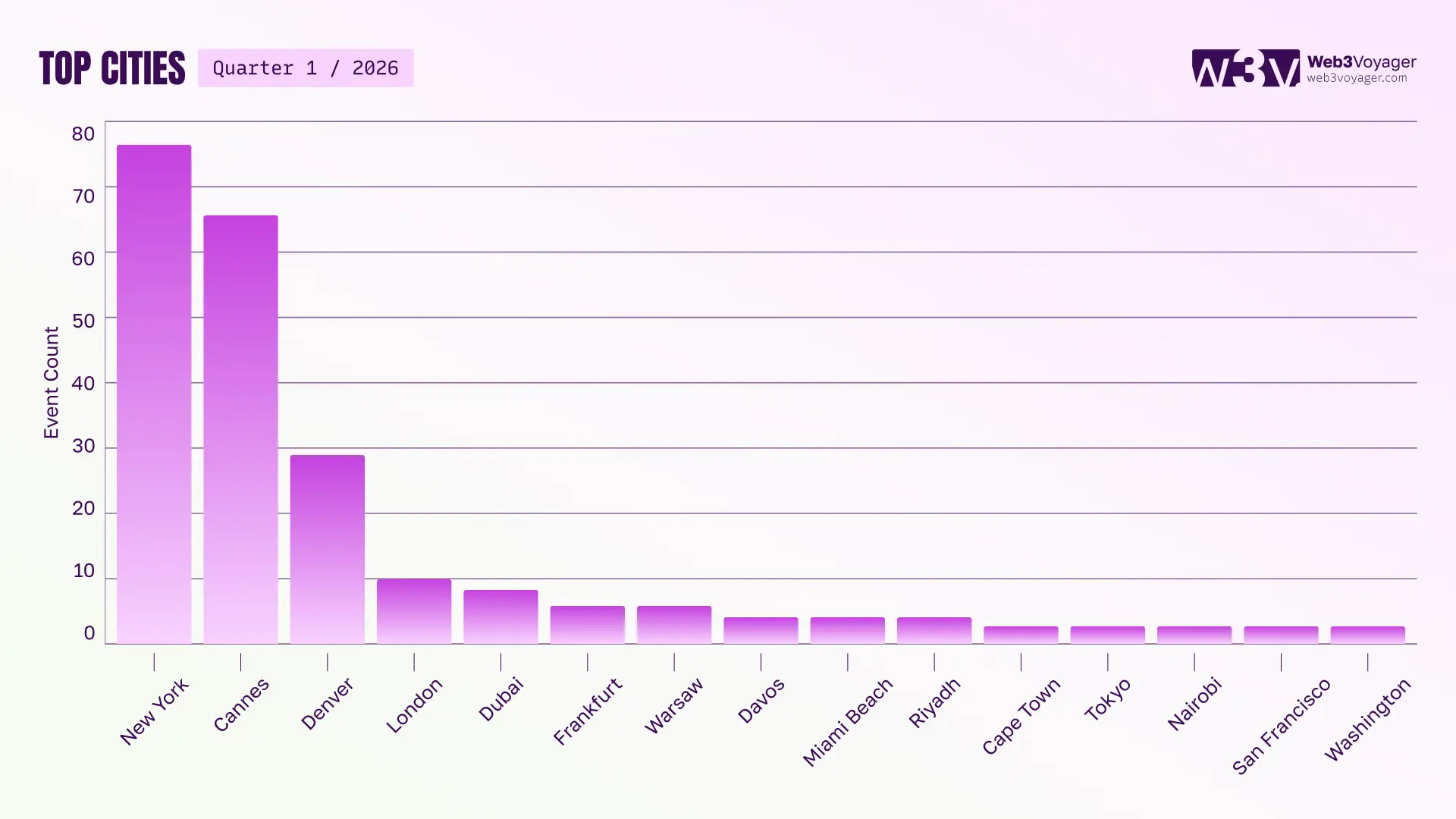
- New York dominated Q1’s institutional layer. DAS generated 73 side events — primarily closed-door dinners, tokenization clinics, stablecoin strategy sessions, and security workshops for C-suite and allocators
- Cannes hosted EthCC[9] and defined European developer momentum. Side events covered DeFi research, staking infrastructure, EUR stablecoin policy, and VC-founder matching. More technically diverse than New York; less finance-focused
- Denver anchored North American developer activity. ETHDenver’s BUIDLathon concentrated side summits around AI, DePIN, real-world assets, and scaling infrastructure in a single campus — the quarter’s most developer-dense venue
- Hong Kong hosted Consensus in February as APAC’s institutional center. The event anchored East-West capital flow discussions, Solana consumer applications, and tokenized capital market infrastructure.
Parent Event Gravity
Event gravity concentrated dramatically: DAS NYC (73 side events) and EthCC[9] (61) dominated. ETHDenver (26) completed the top three, which collectively set the quarter’s agenda. All other events generated modest satellite ecosystems. The Web3 event market is consolidating around three flagship anchors.
Major Hubs
DAS NYC dominated Q1’s institutional landscape. 2,500+ attendees, $4.2T in managed assets, 73 side events spanning March 24-26. The largest satellite ecosystem observed in the quarter.
- Side events were closed-door: dinners, clinics, salons, mixers — all invitation or application-gated. High-value deal-making moved outside the main conference floor into curated small-group settings
- Side event themes: stablecoins as payment rails, RWA tokenization, institutional security, treasury management. These moved from theory to practice — attendees were solving real operational challenges.
EthCC[9] drew 6,500+ developers and researchers with 61 side events across the conference week. The satellite ecosystem was broader and more technical than DAS, reflecting Ethereum’s builder-first community.
- Side events ranged widely: institutional forums (Agora), staking infrastructure (Lido), humanitarian applications, EUR stablecoin policy, token engineering, AI sessions. The breadth showed a community maturing institutionally while pushing experimental boundaries simultaneously
- Physical wellness events (5K runs, workouts) became standard side event format. Community-building rituals now sit alongside technical and networking programming at the conference level.
ETHDenver 2026 centered on the BUIDLathon — a multi-day hackathon with $1.5M+ in bounties. Side events were full-day themed summits, not casual networking—developer-first, execution-focused format.
- AI dominated side summits: Decentralized AI, Open AGI, Applied AI, Agentic Economy. ETHDenver hosted more AI-focused programming than any event in Q1
- Quantum computing, post-quantum cryptography, and privacy architectures (TEEs, FHE, MPC, ZK) appeared as dedicated summit tracks. ETHDenver builders are working on infrastructure challenges beyond the current cycle.
Hackathon Signal
Hackathons in Q1 2026 sent a clear signal: AI agents and autonomous onchain systems replaced DeFi and NFTs as the dominant builder focus. The range was wide — from experimental (Solana’s AI-only hackathon: humans forbidden from submitting code) to enterprise-focused (AlgoBharat). Most ran online for global access, with notable in-person events in India, Bolivia, and Malaysia showing genuine geographic distribution.
Builder Priorities
- AI agents dominated across Solana, Farcaster, 0G APAC, and GenLayer hackathons. Teams focused on agent identity, agent-to-agent coordination, and autonomous trading — the quarter’s most consistent builder signal
- Privacy infrastructure (ZK proofs, FHE, TEEs) ranked second, especially at ETHDenver. Privacy shifted from research topic to production requirement
- RWA tokenization and PayFi appeared in Chainlink, HashKey, and AlgoBharat hackathons. The RWA narrative moved from institutional hype to active builder implementation.
Regional Or Ecosystem Patterns
- Online hackathons dominated: 0G, Chainlink, GenLayer, Initia, Solana Frontier all ran multi-week remote programs. Async, distributed building is now the default format
- APAC builder activity grew: 0G Hackathon, NottsHack (Malaysia), Stellar Build-A-Thon (Kolkata). Developer communities now thrive outside NA/EUR. The 0G $150K prize pool shows serious ecosystem investment in APAC development
- LATAM builder activity was sparse but meaningful: Aleph Hackathon in Bolivia showed grassroots, university-anchored blockchain education reaching underserved markets.
Independent Activity
Standalone events revealed ecosystem depth beyond the flagship conferences. The dataset captured signals the main clusters missed: Bitcoin energy policy (Alaska), grassroots adoption (Sub-Saharan Africa), iGaming convergence (Sri Lanka), privacy advocacy (Japan). Q1 showed an ecosystem that moved from developer-centric to spanning finance, policy, culture, and emerging market infrastructure.
Patterns
- Institutional finance events multiplied as standalone gatherings: Cayman Crypto Week, Tokenized Capital Summit Hong Kong, Liquidity 2026, CBC Summit Europe. All targeted C-suite and allocators outside the main conference circuit. These intimate, deal-focused formats outcompete large conferences
- Bitcoin maintained separate event track: El Salvador, Alaska, Madrid, Prague focused on treasury management, energy policy, sovereign adoption, self-custody. These topics don’t appear in Ethereum or multichain programming
- Emerging market events showed genuine grassroots momentum: Zanziblock (Tanzania), Africa Tech Summit (Nairobi), Aleph (Bolivia), Stellar Build-A-Thon (Kolkata). Local communities build independent infrastructure in markets where financial inclusion and mobile-first adoption drive adoption.
Cross-Cutting Themes
Across all event types and regions, three themes appeared with sufficient consistency and depth to be considered defining characteristics of the quarter. These themes cut across the institutional, builder, and community layers simultaneously, signaling genuine ecosystem-wide shifts.
Themes
- Institutional operationalization of digital assets: The quarter marked a transition from institutional interest to institutional implementation. Tokenization clinics, stablecoin payment rail demonstrations, RWA settlement infrastructure sessions, and institutional security mixers all indicate that TradFi actors are no longer evaluating digital assets but actively building operational infrastructure around them. The presence of SEC leadership, Federal Reserve governors, and executives from BlackRock, JPMorgan, and Swift at DAS NYC as agenda-setters — not just attendees — highlights this shift
- AI-blockchain convergence as the primary builder thesis: AI agents, autonomous onchain systems, DeFAI, and decentralized AI infrastructure appeared across every event type in the dataset — main conference tracks, side event summits, hackathon tracks, and standalone events. This convergence is no longer a speculative theme but an active area of building, with dedicated hackathons, accelerator programs, and investment tracks forming around it. The Solana AI-only agent hackathon, where human code submission was prohibited, represents the experimental frontier of this trend
- Regulatory clarity as an ecosystem accelerator: The US regulatory environment post-policy shift and MiCA’s advancing implementation in Europe were referenced across events in New York, Cannes, London, Paris, and Warsaw. Rather than creating uncertainty, the emerging regulatory frameworks appear to be accelerating institutional participation and providing builders with clearer parameters for compliance-oriented product development. Events like the Crypto Legislative Hackathon in Paris and the CBC Summit Europe demonstrate a community actively engaging with regulatory processes.
Signals and Implications
The quarter’s data points toward an ecosystem undergoing structural maturation on multiple dimensions simultaneously: institutional adoption is accelerating, builder priorities are shifting toward AI-native and privacy-preserving architectures, and the geographic center of gravity is gradually broadening beyond the traditional NA/EUR duopoly. The concentration of side-event activity around a small number of flagship conferences also signals a consolidation dynamic in the event ecosystem itself.
Signals
- The 73-event satellite ecosystem around DAS NYC — the largest observed in the dataset — signals that New York has displaced other US cities as the primary institutional Web3 hub, and that the side event format has become the preferred venue for high-value deal-making and relationship-building among institutional actors who find main conference formats too public or too broad.The consistent appearance of AI agent infrastructure across hackathons, ETHDenver side summits, EthCC side events, and standalone conferences suggests that the next major application wave in Web3 will be agent-nativ, with significant implications for wallet design, identity systems, and onchain coordination mechanisms
- Eastern Europe’s emergence as a meaningful event hub — with Polish Blockchain Week generating 6 side events and ETHSilesia running a 4-day conference-hackathon hybrid in Katowice — signals growing developer and investor community depth in markets that were peripheral in earlier cycles, potentially driven by talent availability and lower event costs relative to Western European cities.
Next Quarter Implications
- Q2 2026 is likely to see Paris Blockchain Week (April 15-16) become the next major institutional gravitational center, with its explicitly MiCA-focused agenda and confirmed participation from S&P Global, Fidelity, Bank of America, and Deutsche Bank suggesting it will generate a side event ecosystem comparable in scale to DAS NYC. The Carrousel du Louvre venue and Versailles closed-door gathering signal an event positioning itself as the European institutional counterpart to DAS
- The volume and diversity of AI-blockchain hackathons launching in Q1 with submission deadlines in Q2 (0G APAC through May, Solana Frontier through May, AlgoBharat through April) means Q2 will likely produce a significant cohort of AI-native Web3 projects entering accelerator pipelines and seeking early-stage funding, potentially defining the next wave of ecosystem investment themes.
The deeper story of Q1 is structural: the event ecosystem itself is reorganizing. Flagship conferences are becoming coordination shells — their real value now lives in the satellite ecosystems they generate, the closed-door dinners, the invitation-only clinics, the side summits where capital commitments are made and builder teams are formed. That dynamic will only intensify in Q2.