

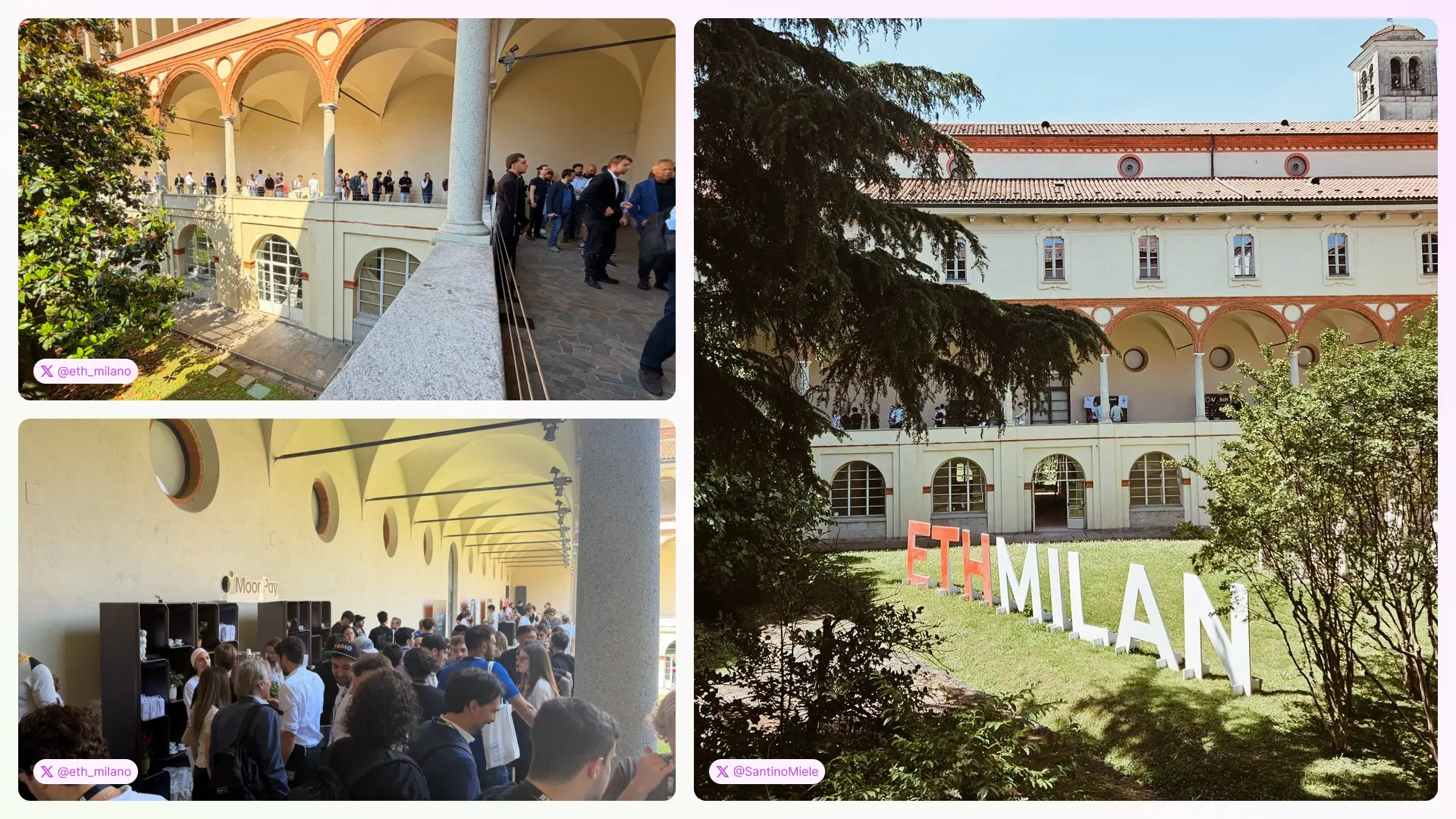
ETHMilan reached its fourth edition this year, on 21 and 22 May, inside the Museo Nazionale della Scienza e della Tecnologia Leonardo da Vinci. The venue matters more than venues usually do: a national science museum named for the most famous polymath in Italian history does not host a crypto conference by accident, and the organisers have wanted the association for a while. Registered attendees were given access to the museum’s permanent exhibitions alongside the panels, so the conference and the institution were physically braided together for two days. By the time the badge queue had formed under the courtyard arches on the first morning, with MoonPay running an espresso station in the covered walkway, the message was hard to miss. This is a conference that wants to be taken seriously by people who do not usually take crypto seriously.
Culture Pays for Finance’s Seat
That ambition is the thread worth following, because ETHMilan is built on a duality it has never tried to resolve. Back in 2024, at Teatro Franco Parenti, the event already ran two named tracks: Create, for the technical material like smart contracts and DeFi infrastructure, and Inspire, for blockchain’s intersection with art, design and storytelling. That structure shows the organisers never treated the cultural framing as decoration. It is closer to a thesis: that the technology earns its place in Italian public life through culture as much as through finance. The 2026 programme carried the idea forward. On the first day, Maurizio Ferraris, among the most widely read philosophers working in Italy, gave an hour-long lecture on the philosophy of blockchain. The same day, in the same building, a Derivatives Summit ran two talks and a panel on DeFi trading infrastructure with named protocols on stage.
A philosopher and a derivatives panel under one roof would be incoherent at most crypto events. At ETHMilan it is the format, and it does real work. The Ferraris lecture gave the conference’s academic and institutional visitors a reason to be in the room that had nothing to do with token prices, and it let the harder commercial material proceed without the event tipping into a trade show. Whether the philosophy was any good is a separate matter – its function was to hold the door open for an audience a pure DeFi conference would never attract, and on that count it succeeded.
The Institutional Case and Its Limits
The pitch was not only cultural. By the second day the organisers were describing Milan as an emerging European hub for digital assets, and the claim deserves more scrutiny than a slogan usually gets, because parts of it hold up. The speaker list leaned on regulated finance: a director from 21Shares, which issues crypto exchange-traded products; a co-founder working on cross-chain stablecoin liquidity in the Tether orbit; lawyers who advise clients on MiCA, the EU’s crypto-asset regime. That roster assembles where the regulatory and capital-markets conversation is happening, and in 2026 the EU is a natural home for that conversation, since MiCA gave crypto businesses a single written rulebook that much of the world still lacks.
The weaker part is the specific claim about Milan. Italy is not the obvious centre of European crypto finance, and that title, wherever it lands, is contested by jurisdictions with deeper banking infrastructure. But the number of European cities willing to stage an event like this, at a venue like this, with this blend of institutions and culture, is smaller than the hub framing implies. The organisers’ own and more modest line, that the conference has cemented Milan as the DeFi capital of Italy and Southern Europe, is closer to the truth. The hub claim is the aspirational edition of a real position.
Off the Main Stage
A conference like this is never only what happens on its stages. The week filled with the usual satellite programming: a rooftop party on the SACE Terrace the night before the doors opened, an early-morning community run through Parco Sempione, small invite-only gatherings for the DeFi crowd that produce more deals than posts. Two days before any of it, an AI agent hackathon ran at the Fiera Milano complex in Rho with a prize pool above $28,000, part of a parallel Milan AI Week. That detail is worth keeping, because it shows where the AI-and-crypto crossover actually lives: among builders, at a separate venue, rather than on the main stage where the agentic-payments track promised it.
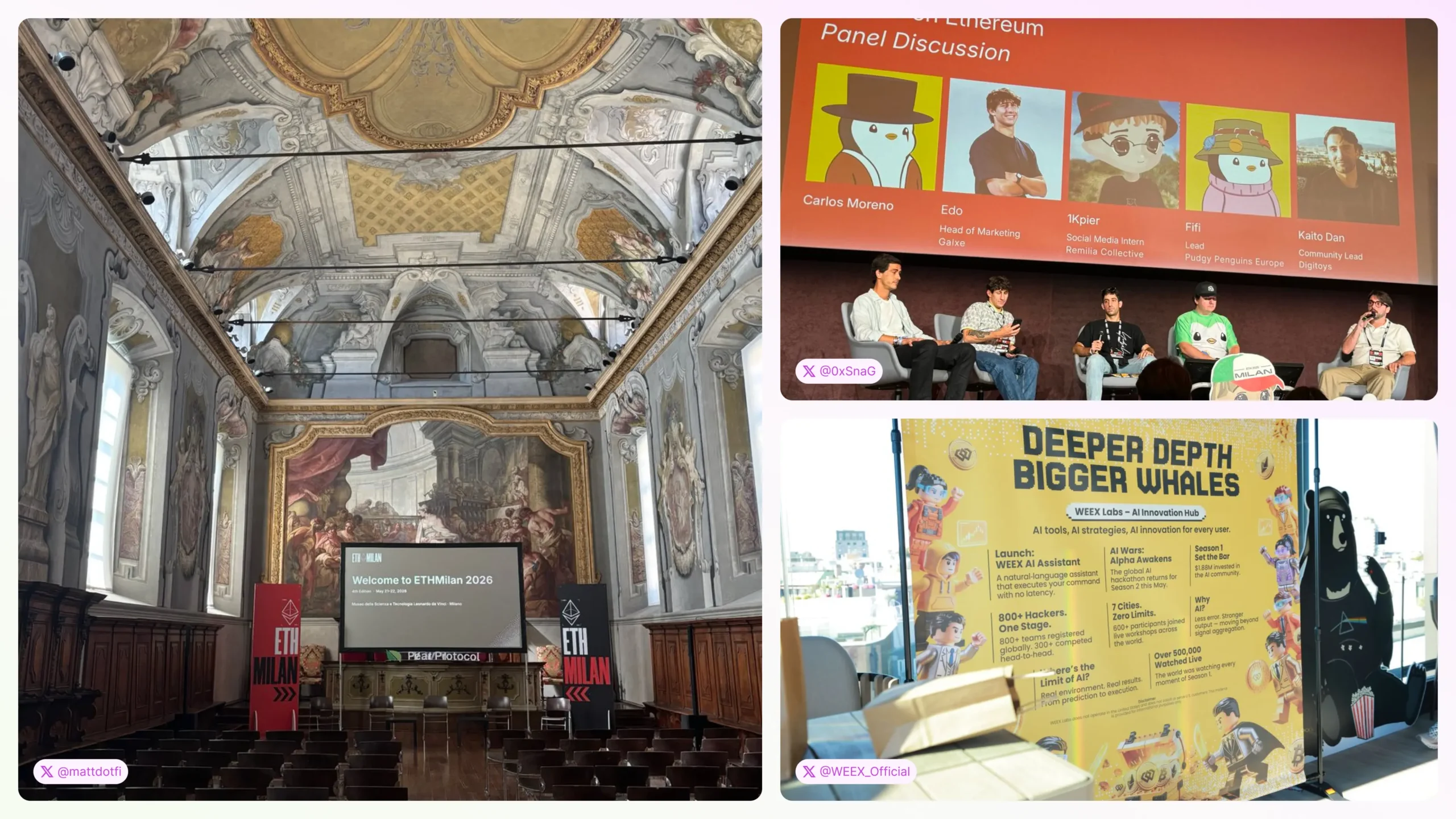
The loudest presence online during the first day belonged to a sponsor, not the conference itself. WEEX Labs ran the rooftop activation with Pudgy Penguins and Berachain, then pushed the same images, the same banner and the same slogan across its regional accounts in six languages. The result was a feed that looked like organic enthusiasm and was closer to coordinated distribution. The unscripted posts were quieter: a speaker glad to be on stage, a team photographing the courtyard signage and a matcha. They give a truer read of who was actually in the building, and they point at a smaller, warmer event than the sponsor blast suggested.
The Case Against Three Tracks
The final afternoon put the conference’s whole range on display. A Global Pizza Party, run with PizzaDAO, took over the museum on 22 May to mark the anniversary of the first real-world Bitcoin purchase. A Bitcoin tradition celebrated inside an Ethereum venue would have carried some friction a few years ago, and now it carries none, because the tribal lines that once separated the two camps have mostly worn away. That night, a strict invite-only party for the DeFi community ran on a tram moving through the city into the early hours. The bank-sponsored panels and the invitation-only tram belonged to the same week and to noticeably different crowds. The people who run the protocols still prefer their own rooms, even with the institutions installed in the main hall.
The forward-looking announcement came during the event: a 2027 edition reorganised into three tracks, enterprise, institutional, and community. It was framed as growth. It may instead remove the one quality that made 2026 work. The strength of this year’s edition was proximity. The regulatory lawyer and the anonymous developer queued at the same espresso cart, and the philosopher lectured in the same building as the derivatives traders. Formal tracks that wall those audiences off from each other take away the friction that produced the interesting collisions in the first place. Run cleanly, a three-track structure turns one unusual conference into three ordinary ones that share a city and a date.
Keeping the crowds mixed, and tolerating the mess that comes with it, would be the harder and the better choice. The 2027 programme will show whether the organisers agree.